Overview
·
A
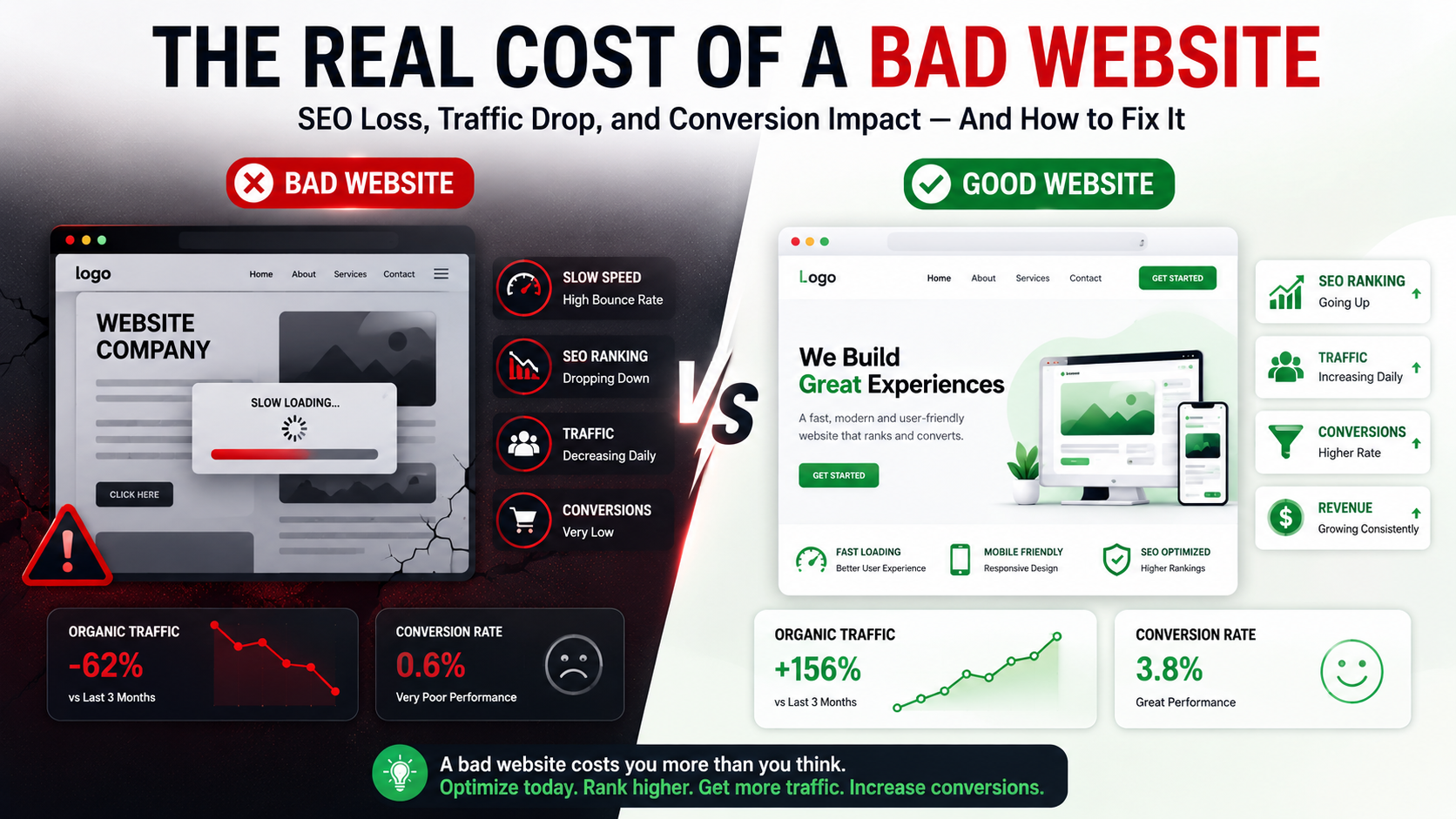
bad website costs Nepali businesses in four direct ways — lower. Google
rankings, higher bounce rates, fewer conversions, and damaged brand trust
·
Users
form an opinion about your website within 3 seconds , a slow or confusing site
loses them immediately
·
Even
a one second delay in page load time reduces conversions by up to 20 percent
·
Poor
mobile experience is especially damaging in Nepal where over 80 percent of
users browse on smartphones
·
Most
bad website problems are fixable without a complete rebuild
·
Businesses
that fix their websites consistently see measurable improvements in rankings
and conversions within 60 to 90 days
·
Every
day an unoptimized website stays live is a day of lost traffic, leads, and
revenue
Most Nepali businesses know their
website could be better. The design feels dated. Pages take a few seconds too
long to load. The mobile version is difficult to navigate. Inquiries are not
coming in the way they should be.
But very few businesses understand
just how much that bad website is actually costing them right now. It is not
just a design problem sitting quietly in the background. A poor website is
actively working against your business every single day it stays live.
This guide breaks down the real
cost of a bad website for Nepali businesses, explains exactly how each problem
damages your business performance, and gives you a clear practical path to
fixing it.
How Much Is a Bad Website
Actually Costing Your Nepali Business?
Imagine a Nepali service business
getting around 1,000 website visitors per month. If only 1% of those visitors
turn into inquiries, that means just 10 inquiries. But if the website is
improved—faster loading, easier navigation, mobile-friendly design, and clear
call-to-action—the conversion rate can increase to 3%, which becomes 30
inquiries from the same traffic. If each inquiry is worth around NPR 20,000,
then the business earns about NPR 2,00,000 with a poor website and NPR 6,00,000
with an optimized one. That’s a difference of around NPR 4,00,000 per month,
simply from improving the website.
This clearly shows that the traffic
is not the main issue—the real problem is that many websites fail to convert
visitors into customers. In Nepal, most users who search on Google already have
strong buying intent. They are ready to take action, but if they land on a
slow, confusing, or unprofessional website, they don’t wait. They simply go
back and choose the next result, which is often a competitor.
How
Does a Bad Website Hurt Your Google Rankings in Nepal?
Google does not rank websites only
based on content. It also checks how real users interact with your site. If
people leave quickly without reading or clicking, Google sees it as a sign that
your website is not helpful.
When this happens often, your
rankings slowly drop. This creates a cycle: poor website → low engagement →
lower ranking → fewer visitors → even fewer customers.
Several things cause this, like
slow loading speed, poor mobile experience, confusing navigation, and weak SEO
structure (titles, headings, meta tags). Google also uses mobile-first
indexing, so a bad mobile site hurts rankings even more.
For Nepali businesses doing SEO, a
poor website reduces the impact of all efforts like content and backlinks.
Fixing the website first makes every other SEO strategy actually work better.
How
Does Poor User Experience Block Inquiries and Sales on Nepali Websites?
User experience is the overall
quality of the journey a visitor takes through your website. When UX is poor,
users cannot find what they need, do not understand what action to take, and
leave without converting. When UX is strong, users move smoothly from arrival
to the action your business needs them to take, whether that is making a
purchase, filling in a contact form, calling your number, or booking a
consultation.
The most common UX problems on
Nepali business websites fall into clear categories.
1. Confusing Navigation
When a visitor lands on your
website and cannot immediately understand how to find what they came for, they
leave. Navigation menus with too many items, unclear category names, and no
clear path from the homepage to the most important pages are among the most
common conversion killers on Nepali websites.
The fix is simple in principle.
Your navigation should reflect what your visitors are looking for, not how your
internal team thinks about your business. A visitor looking for pricing
information should be able to find it in two clicks. A visitor looking to
contact you should see your contact option without scrolling or searching.
2. Unclear or Missing Calls to
Action
Many Nepali business websites tell
visitors what the company does but never clearly tell them what to do next.
There is no obvious button for requesting a quote. No prominent phone number.
No clear next step. The visitor reads about the service and then has nowhere
obvious to go, so they leave.
Every page of your website should
have one primary call to action that is visually prominent and clearly worded.
Call us for a free consultation. Request a quote today. Book your appointment
here. The action should be immediately obvious without the visitor having to
think about what to do.
3. Poor Mobile Experience
More than 80 percent of Nepali
internet users browse on mobile devices. If your website was designed for
desktop and has not been properly adapted for mobile, the majority of your
visitors are having a fundamentally broken experience. Text that is too small
to read. Buttons that are too close together to tap accurately. Forms that
require horizontal scrolling. Images that overflow their containers.
Google's mobile-first indexing
means this also directly hurts your rankings on top of the conversion damage it
causes.
4. Weak and Generic Content
Many Nepali business websites have
content that could have been written for any company in any country. Generic
descriptions of services with no specific information about pricing, process,
what makes the business different, or what a customer can realistically expect.
This content fails to build trust or answer the questions that Nepali customers
actually have before they make a decision.
Content that converts is specific.
It answers real questions. It addresses real concerns. It gives enough
information for a potential customer to feel confident taking the next step.
What Does a Bad Website
Cost Your Brand Trust in Nepal?
In Nepal's digital market, trust is
still the biggest barrier to online transactions. Nepali customers,
particularly those making a purchase or inquiry for the first time, are
evaluating your business on every signal they can find. Your website is one of
the most powerful trust signals available.
A professionally designed,
fast-loading, well-organized website says your business is legitimate,
established, and competent. It does not guarantee a sale but it removes doubt
and makes the decision to contact you easier.
A poorly designed, slow, outdated,
or confusing website does the opposite. It introduces doubt even for customers
who found you through a trusted referral. It makes potential customers hesitate
at exactly the moment you need them to act. And in a market where word of mouth
and reputation are enormously important, a bad first impression online can
affect how potential customers perceive your business before they have ever
spoken to you.
Nepal context: Consider a Nepali
user searching for a professional service such as accounting, legal advice, or
digital marketing. They find two options in Google results. One has a fast,
professional, clearly organized website with clear service descriptions,
visible pricing ranges, client testimonials, and an obvious way to get in
touch. The other has a slow-loading site with stock photos, generic text, and
no clear pricing or process information. Even if the second business is
objectively more experienced and delivers better results, the first one wins
the inquiry in most cases. The website is doing the selling before a single
conversation happens.
How to Fix a Bad Website
Without Rebuilding It from Scratch
The most important thing to
understand about website problems is that a complete rebuild is rarely
necessary and almost never the right first step. The majority of the issues
that are costing Nepali businesses rankings and conversions can be fixed through
systematic optimization of what already exists.
1. Fix page speed: Page
speed has the highest impact on both Google rankings and user
experience. If your current plan is on cheap shared hosting with a server
outside Nepal then compress all images, set up caching, enable a CDN
through Cloudflare which has a free plan, and consider upgrading hosting
2. Fix mobile experience: Most of
your users are on mobile and Google is evaluating your mobile site for
rankings. Check every page on an actual Android smartphone, not just a browser
resize. Fix anything that requires zooming, causes horizontal scrolling, or
makes tap targets too small.
3. Fix your calls to action: This
directly affects how many visitors become inquiries or customers. Every page
needs a clearly instructed next step. Make your phone number visible
without scrolling on every page. Make your contact or quote request button
prominent in your header and at the bottom of every service page.
4. Fix your content: Replace
generic descriptions with specific ones that mention your location, your
pricing range, your process, and your experience. Add real testimonials from
real Nepali customers also add a FAQ section that answers the actual
questions your sales team hears every day.
5. Fix your site structure:
Google can crawl and understand it clearly is site structure is
clear. You need to make sure that every important page has a
clear descriptive title tag and meta description and heading
structure uses H1, H2, and H3 tags correctly as well as most
important pages are no more than two clicks from your homepage.
How Long Does It Take to
See Results After Fixing a Bad Website in Nepal?
The timeline for seeing measurable
improvement after website optimization depends on which problems are being
fixed and how significant they were.
Page speed improvements produce
immediate results in Google PageSpeed scores and user experience from the
moment they are deployed. The impact on Google rankings from improved Core Web
Vitals typically appears within 4 to 8 weeks as Google recrawls and re-evaluates
the site.
Conversion rate improvements from
better UX and clearer calls to action appear immediately in the traffic that
arrives after the changes. If 1,000 people visited your website in the month
before and 1,000 visit in the month after, the difference in inquiries
generated shows up directly in that next month's numbers.
SEO ranking improvements from
better site structure, content quality, and technical fixes typically appear
within 6 to 12 weeks for pages that Google has already indexed. New pages and
newly optimized content may take longer to rank depending on competition for
the target keywords.
The businesses that see the fastest
results are the ones that fix the most critical issues first rather than trying
to improve everything at once. Start with page speed and mobile experience.
Then improve calls to action and navigation. Then improve content quality and
SEO optimization. This sequencing produces the fastest measurable improvement.
Frequently Asked
Questions
1.
How do I know if my website is hurting my Google rankings in Nepal?
Ans: Test your website at
pagespeed.web.dev and check your mobile score. Search Google for your main
service plus your city and see which page your website appears on. Check Google
Search Console for any Core Web Vitals issues or coverage errors. If your mobile
PageSpeed score is below 60 or your website does not appear in the first three
pages for your main service keyword, your website is almost certainly hurting
your rankings.
2. Is it better to redesign or
optimize an existing bad website in Nepal?
In most cases, optimize first.
Redesign is needed only if the website is outdated, broken, or built on poor
structure. Optimization is cheaper and gives faster results.
3. How much does fixing a bad
website cost in Nepal?
Basic optimization costs around NPR
15,000–40,000. Advanced improvements cost NPR 40,000–1,00,000. Full redesign
can start from NPR 1,50,000 or more.
4. Can a bad website affect my
Facebook ad performance in Nepal?
Yes. If your landing page is slow or
confusing, people won’t convert even if you pay for ads. This increases your
cost per customer.
5. What is the most important
thing to fix first on a bad Nepali website?
Ans: Page speed and mobile
experience are almost always the highest-priority fixes because they affect
both Google rankings and every visitor's experience simultaneously. If your
mobile Page Speed score is below 60, fixing that single issue will produce measurable
improvements in rankings and conversions faster than any other single change.
Conclusion
A bad website is not a small
issue—it quietly reduces your business performance every day while competitors
move ahead. If your website is slow, many visitors leave before even seeing
your content. If navigation is confusing, interested users leave without
contacting you. If your site is not optimized for Google, customers are going
to competitors instead of you.
This means a poor website is
constantly costing you traffic, rankings, and potential customers every single
day.
The good news is you don’t always need to rebuild everything. Start by identifying problems—check your website speed, see how you rank on Google, and test your site on a mobile phone. These simple checks will clearly show what needs to be improved first.