Overview
·
A
KPI (KEY PERFORMANCE INDICATOR) is a measurable value that shows whether
your business is actually achieving its goals
·
Most
Nepali businesses track the wrong metrics or track too many, which leads to
confusion rather than clarity
·
A
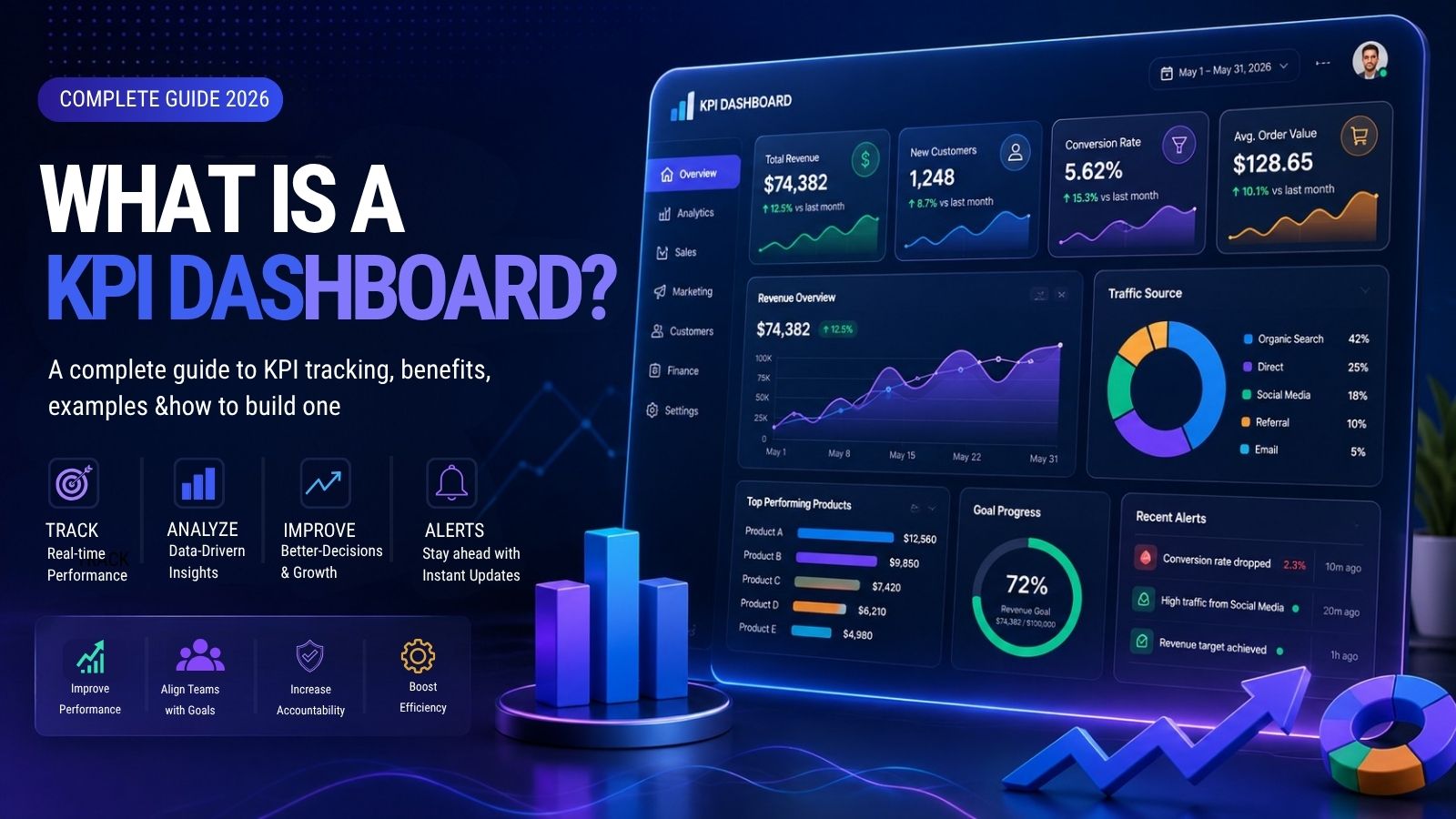
KPI dashboard brings the most important metrics into one visual
place which helps us to see what is happening at a glance
·
Good
KPIs follow the SMART framework (Specific, Measurable, Achievable, Relevant,
and Time-bound)
·
Google
Looker Studio is free and powerful enough for most Nepali businesses no need
expensive software
·
If
more than 5 to 10 KPIs are tracked it creates noise, not
insight.
Here is a question every Nepali
business owner should be able to answer right now. Is your business actually
growing, or is it just staying busy?
Most business owners in Nepal would
say things feel busy. The team is working hard. Orders are coming in. The phone
is ringing. But when you ask whether revenue is growing faster than costs,
whether marketing spend is producing profitable customers, whether customer
satisfaction is improving or declining, or which product line is actually
driving profit — the honest answer is often that nobody knows for certain.
That uncertainty is expensive.
Decisions made without clear performance data are often wrong in ways that take
months to discover. Marketing budgets go to channels that feel active but are
not producing returns. Operational problems grow slowly until they become
crises. Teams work hard on priorities that turn out not to matter.
KPI tracking and KPI dashboards
solve this problem by giving businesses a clear, consistent, honest view of how
they are actually performing against the goals that matter most.
What Is a KPI and Why
Does It Matter for Nepali Businesses?
KPI stands for Key Performance
Indicator. A KPI is a specific, measurable value that tells you whether your
business is moving toward a defined goal or away from it.
The word key is important here. Not
every number that can be measured is a KPI. A KPI is a metric that is directly
connected to something your business is trying to achieve. If your goal is to
grow monthly revenue by 20 percent, then monthly revenue is a KPI. If your goal
is to improve customer retention, then your repeat purchase rate or customer
churn rate is a KPI.
The reason KPIs matter so much for
Nepali businesses right now is that most businesses are operating in an
increasingly competitive environment without a clear dashboard of whether their
strategies are working. They are navigating by feel rather than by instruments.
That approach works when markets are forgiving and competition is low. It
becomes genuinely dangerous as markets mature.
Nepal context: A Kathmandu-based
digital marketing agency might feel successful because they are winning new
clients every month. But if their KPIs showed that average client lifetime was
only four months, that client acquisition cost had increased by 40 percent over
the past year, and that their most profitable client segment was actually small
ecommerce businesses rather than the enterprise clients they were pitching to,
those insights would completely change how they allocate their sales and
delivery resources. Without KPI tracking, they would never see these patterns
clearly enough to act on them.
What Are the Three Main
Types of KPIs?
Understanding which type of KPI you
need for which purpose saves a lot of confusion when building your tracking
system.
1. Strategic KPIs: Strategic KPIs track long-term
business performance and are typically reviewed monthly or quarterly by senior
leadership. Examples include annual revenue growth, market share, customer
lifetime value, and overall profitability. These KPIs tell you whether the
business as a whole is moving in the right direction over time.
2. Operational KPIs: Operational KPIs track day-to-day
business performance and are typically reviewed daily or weekly. Examples
include daily sales volume, website traffic, number of customer inquiries
handled, and order fulfillment time. These KPIs tell you whether the business
is running smoothly right now and alert you quickly when something is going
wrong.
3. Functional KPIs: Functional KPIs are specific to
individual departments or teams. Marketing teams track click-through rates,
cost per lead, and conversion rates. Sales teams track pipeline value, win
rates, and average deal size. Customer service teams track response time,
resolution rate, and customer satisfaction scores. Finance teams track gross
margin, cash flow, and accounts receivable days. Each department needs its own
KPIs aligned with both their specific function and the broader business goals.
What
Is a KPI Dashboard and What Should It Include?
A KPI dashboard is a visual display
that brings your most important performance metrics together in one place,
updated regularly so you can see what is happening across your business at a
glance.
Think of it as the instrument panel
of a vehicle. A driver does not manually calculate speed, fuel level, engine
temperature, and navigation while driving. Those numbers are displayed clearly
so the driver can stay focused on the road while remaining aware of everything
important. A KPI dashboard does the same thing for your business.
A well-built KPI dashboard for a
Nepali business typically includes current performance versus target for each
key metric, trend lines showing whether performance is improving or declining
over time, comparison to the same period last year or last month, visual alerts
when metrics fall outside acceptable ranges, and a clean simple layout that
takes seconds to read rather than minutes to interpret.
The four main types of dashboards
serve different purposes. Executive or strategic dashboards show the big
picture for senior leadership and are reviewed monthly or quarterly.
Operational dashboards show daily activity and are reviewed daily or weekly by
team managers. Analytical dashboards support deep analysis of specific business
questions and are used when investigating a performance issue. Tactical
dashboards support mid-level management decisions like campaign optimization or
departmental resource allocation.
How to Build KPIs That
Actually Work for Your Nepali Business
Here
is a step-by-step approach that works.
Step
1: Start With Your Business Goals
Every KPI must connect directly to
a specific business objective. Before choosing any metric, write down your top
three to five business goals for the next 12 months. For a Nepali ecommerce
business this might be increasing monthly revenue, improving repeat purchase
rate, and reducing customer acquisition cost. For a service business it might
be growing the client base, improving client retention, and increasing average
project value.
Step
2: Choose Metrics That Directly Measure Progress Toward Those Goals
For each goal, identify one to
three metrics that honestly and directly show whether you are making progress.
Revenue growth measures directly whether the revenue goal is being achieved.
Repeat purchase rate measures directly whether customer retention is improving.
Cost per acquisition measures directly whether you are getting more efficient
at winning new customers. Resist the temptation to add metrics that feel good
but do not connect to goals. Social media follower count is a vanity metric
unless growing your audience is directly connected to a specific revenue or
awareness goal with a clear link between followers and business outcomes.
Step
3: Apply the SMART Framework
Every KPI should be Specific,
Measurable, Achievable, Relevant, and Time-bound. The difference between a weak
KPI and a strong one is usually specificity and timeline. Weak KPI increases
website traffic and strong KPI increases organic website traffic from Google
Nepal by 30 percent within 90 days compared to the previous 90-day period.The
strong version tells you exactly what you are measuring, how you will measure
it, what success looks like, why it matters, and when you expect to achieve it.
Step
4: Identify Your Data Sources
Once you know what to measure,
confirm that you can actually measure it reliably. Website traffic comes from
Google Analytics. Sales data comes from your point of sale system or ecommerce
platform. Customer satisfaction scores come from post-purchase surveys or
review data. Lead conversion rates come from your CRM. If you cannot identify a
reliable data source for a KPI, either fix your data collection first or choose
a different metric you can measure accurately.
Step
5: Set Benchmarks and Targets
Define what good performance looks
like for each KPI based on your historical data or industry benchmarks. A
conversion rate above 3 percent for a Nepali ecommerce site. A customer
satisfaction score above 4.2 out of 5. A monthly revenue growth rate of at
least 8 percent. These benchmarks give your dashboard meaning because every
number can be instantly interpreted as above, on, or below where it should be.
Step
6: Build Your Dashboard and Review It Consistently
Choose a tool, set up your
dashboard, and then commit to reviewing it on a consistent schedule. A
dashboard that is looked at once a month when someone remembers to check it is
not a KPI system. It is just a report. Real KPI tracking means weekly reviews
at minimum for operational metrics and monthly reviews for strategic metrics,
with clear accountability for who is responsible for each metric and what
happens when one falls below target.
What Tools Can Nepali
Businesses Use to Build KPI Dashboards?
The good news is that you do not
need expensive enterprise software to build an effective KPI dashboard. Several
powerful options are available at low or no cost.
·
Google
Looker Studio is completely free and connects directly to Google Analytics,
Google Ads, Google Sheets, and many other data sources.
·
Microsoft
Power BI offers a free version with strong capabilities for businesses that are
already working within the Microsoft ecosystem. It handles larger datasets well
and offers more advanced analytics features than Looker Studio for businesses
that need them.
·
Tableau
is a premium tool used by larger organizations that need sophisticated data
visualization and analysis capabilities.
·
Google
Sheets or Microsoft Excel remain genuinely useful for businesses starting out
with KPI tracking.
The right tool for your Nepali
business is the simplest one that gives you reliable access to the metrics you
need. Start with what you can actually use consistently rather than
implementing the most impressive tool your team will not adopt.
Real KPI Dashboard
Examples Relevant to Nepal
1.
Ecommerce Business in Nepal
A Nepali ecommerce store selling
fashion or electronics might track monthly revenue versus target, average order
value, conversion rate, cart abandonment rate, customer acquisition cost by
channel, and repeat purchase rate. These six metrics together tell the full
story of whether the business is growing efficiently and whether customers are
satisfied enough to return.
2.
Digital Marketing Agency in Nepal
A Nepali digital marketing agency
might track total active clients, average client lifetime in months, monthly
recurring revenue, client satisfaction score, cost per new client acquired, and
average revenue per client. Together these reveal whether the agency is growing
sustainably or winning clients it cannot retain.
3.
Restaurant or Hospitality Business in Nepal
A Nepali restaurant might track
daily covers served versus target, average spend per customer, table turnover
rate, food cost as a percentage of revenue, customer review score across Google
and Facebook, and repeat visit rate for loyalty program members. These metrics
give management a daily read on whether the business is performing efficiently
and whether customers are happy enough to return.
4.
Service Business in Nepal
A Nepali consultancy, law firm, or
accounting practice might track monthly billable hours, revenue per client,
client retention rate, proposal win rate, and average project margin. These
metrics reveal whether the business is pricing correctly, retaining clients,
and operating at the right utilization level.
What
Are the Most Common KPI Tracking Mistakes Nepali Businesses Make?
1.
Tracking Too Many Metrics
The most common mistake is trying
to track everything. When a dashboard has 30 metrics, nobody can process what
it means quickly enough to act on it. Five to ten well-chosen KPIs are far more
valuable than 30 metrics that create noise.
2.
Choosing Vanity Metrics Over Impact Metrics
Vanity metrics are numbers that
look impressive but do not connect to business outcomes. Total website
sessions, total social media followers, and total number of email subscribers
are vanity metrics if they are not connected to revenue, conversion, or retention
goals. Impact metrics are numbers that directly reflect whether the business is
achieving its objectives.
3.
Setting KPIs Without Setting Targets
A metric without a target is just a
number. Without knowing whether 500 website visits per day is good or bad for
your specific business, that number cannot drive a decision. Every KPI needs a
defined target so performance can be instantly interpreted as acceptable or
requiring action.
4.
Building Dashboards Nobody Reviews
The most expensive KPI mistake is
building a dashboard and then not looking at it consistently. KPI tracking only
creates value when the numbers are reviewed regularly by people with the
authority to act on what they find.
5.
Failing to Update KPIs as the Business Changes
KPIs that were right for your
business 18 months ago may not be the right ones now. As your business grows,
enters new markets, or changes its strategy, your KPIs need to be updated to
reflect what actually matters in the current phase of the business.
Frequently Asked
Questions About KPI Tracking in Nepal
1. How
many KPIs should a small Nepali business track?
Five to ten KPIs is the right range
for most small Nepali businesses. This is enough to give a comprehensive view
of business performance without creating so many metrics that focus becomes
impossible. Start with fewer rather than more and add only when a clear case
exists for why an additional metric is needed.
2. What
is the difference between a KPI and a metric?
Every KPI is a metric but not every
metric is a KPI. A metric is any measurable data point. A KPI is a metric that
is specifically chosen because it directly measures progress toward a business
goal. Page views are a metric. Page views from organic Google search as a
measure of SEO progress toward a traffic growth goal is a KPI.
3. How
often should Nepali businesses review their KPI dashboards?
Operational KPIs should be reviewed
daily or weekly by the team members responsible for them. Strategic KPIs should
be reviewed monthly by leadership. A quarterly review of whether the right KPIs
are being tracked is also valuable as business priorities evolve.
4.
Can I build a KPI dashboard without technical skills?
Yes. Google Looker Studio and
Google Sheets both allow non-technical users to build useful dashboards. The
harder skill is not the tool but knowing which metrics to track and how to
interpret what you see. Start simple, learn what the numbers mean for your
specific business, and add complexity gradually.
5. What
is the first KPI a Nepali business should track?
Revenue versus target is always the
most important starting point. If you track nothing else, knowing whether your
revenue is above or below where it should be this month relative to last month
and last year gives you the foundation for every other business decision.
Conclusion
KPI tracking is not a sophisticated
tool reserved for large corporations. It is a basic discipline of running a
business well that is accessible to any Nepali business owner willing to be
honest about what they are actually trying to achieve and whether they are
achieving it.
The businesses in Nepal that build
strong KPI practices now will make better decisions, waste fewer resources,
identify problems earlier, and seize opportunities their competitors miss
because they are navigating by clear instruments rather than by feel.
The starting point is not a
dashboard or a software tool. The starting point is a clear answer to one
question: what are the three most important things your business needs to
achieve in the next 12 months? Once you can answer that clearly, everything else
follows naturally. Define your goals. Choose metrics that honestly measure
progress toward them. Set targets. Build a simple dashboard. Review it
consistently. Act on what you find. That discipline, applied every week for 12
months, will change how your business operates more than any marketing campaign
or technology investment.