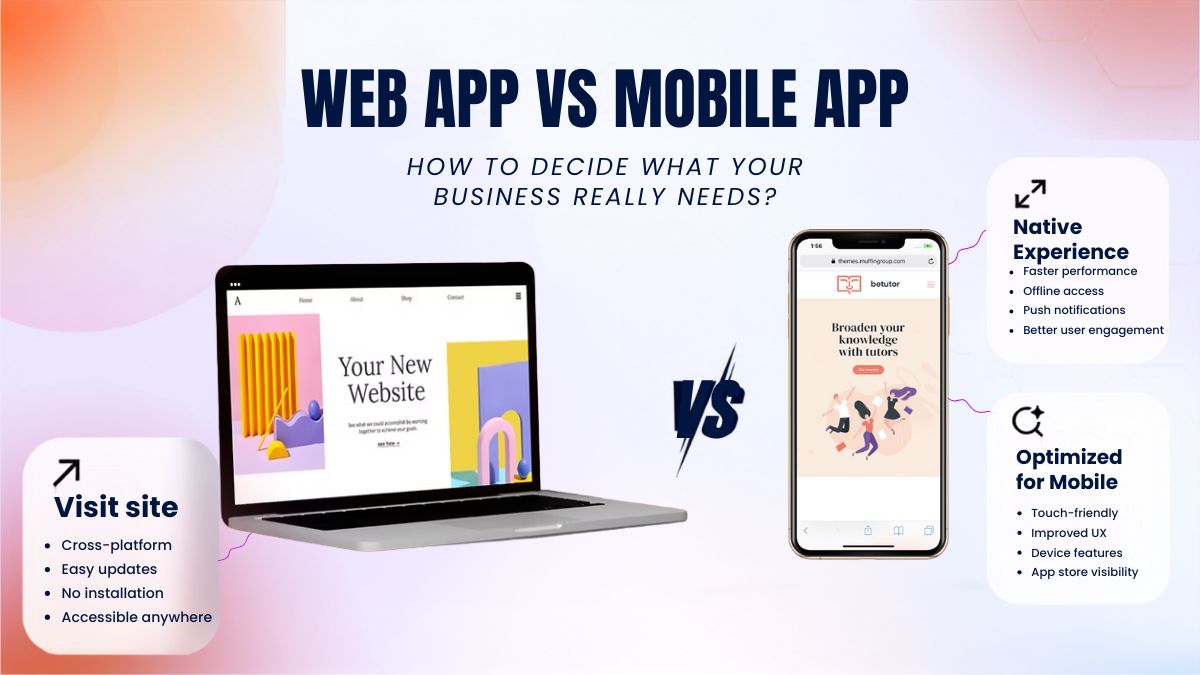
Overview
·
Most
Nepali businesses should start with a web app, validate demand, then build a
mobile app if needed.
·
Web
apps run in browsers, require no installation, and are ideal for fast launch
and low budget.
·
Mobile
apps are installed on phones and are best for features like GPS, camera,
offline access, and push notifications.
·
Mobile
app development in Nepal is significantly more expensive than web app
development.
·
Progressive
Web Apps (PWAs) offer a middle ground between web and mobile apps for many use
cases.
·
Choosing
between web and mobile apps should depend on user behavior and business goals,
not trends or appearance.
·
Many
Nepali businesses waste money by building mobile apps too early without
validating demand.
·
The
best approach is to start simple, validate users, and scale to mobile only when
necessary.
Understanding the
Difference
What
Is a Web App?
A web app runs in a browser such as
Chrome or Safari and is accessed through a URL. Users do not need to download
or install anything.Examples include online banking portals, booking systems,
CRM platforms, and SaaS applications.
Benefits
of Web Apps
a.
No
installation required
b.
Works
across devices and operating systems
c.
Lower
development and maintenance costs
d.
Instant
updates for all users
What
Is a Mobile App?
A mobile app is downloaded from the
Google Play Store or Apple App Store and installed directly on a device.
Examples include ride-sharing platforms, mobile wallets, fitness trackers, and
social media applications.
Benefits
of Mobile Apps
a.
Access
to device hardware such as camera, GPS, and biometrics
b.
Push
notifications for user engagement
c.
Better
offline functionality
d.
Faster
performance for complex tasks
e.
Stronger
home-screen presence
What
Is a Progressive Web App (PWA)?
A Progressive Web App combines the
accessibility of a website with some features of a mobile app. Users can
install it directly from a browser, receive notifications on supported devices,
and enjoy a fast, app-like experience without downloading a traditional app.
For many Nepali businesses, PWAs offer the ideal balance between functionality
and cost.
When Should You Choose a
Web App?
For
most businesses, a web app is the best place to start.
Choose
a web app if:
a.
You
are launching a new product or startup.
b.
You
want to test market demand quickly.
c.
Your
product does not require GPS, camera access, or offline functionality.
d.
You
have a limited budget.
e.
You
want users to access your service instantly through a link.
Web apps reduce barriers to entry,
making it easier to acquire users and gather feedback. They are also faster and
more affordable to build, which is especially important for startups and small
businesses.
When Should You Choose a
Mobile App?
A mobile app becomes valuable when
device integration and user engagement are central to your product.
Choose
a mobile app if:
a.
Your
service depends on GPS tracking.
b.
You
require camera or document scanning features.
c.
Offline
access is important.
d.
Push
notifications are critical for retention.
e.
Users
interact with your product daily.
f.
You
already have a validated and active user base.
For services such as ride-sharing,
delivery tracking, digital wallets, healthcare apps, and fitness platforms, a
mobile app often provides a significantly better user experience.
Development Costs in
Nepal
While
costs vary depending on complexity, the following ranges provide a general
guideline:
1. Simple Web App: NPR 1,50,000 –
3,00,000
2. Medium Web App: NPR 3,00,000 –
7,00,000
3. Complex Web App: NPR 7,00,000+
4. Simple Android App: NPR 2,00,000
– 4,00,000
5. Android & iOS App: NPR
5,00,000 – 12,00,000
6. Enterprise Mobile App: NPR
12,00,000 or above
7. Progressive Web App: NPR
2,00,000 – 5,00,000
For early-stage businesses, the
difference between building a web app and a full-featured mobile app can be
several lakhs of rupees. That budget difference can often be better spent on
improving the product, marketing, and acquiring users.
Why Progressive Web Apps
Are Growing in Nepal
Progressive
Web Apps are becoming increasingly popular because they offer many app-like
features without the cost and complexity of native app development.
A
PWA can:
·
Be
installed directly from a browser
·
Load
quickly even on slower internet connections
·
Support
limited offline access
·
Send
notifications on supported devices
·
Work
across multiple platforms
For
ecommerce stores, food delivery services, local marketplaces, booking
platforms, and content-based businesses, a PWA can provide excellent value for
money.
Recommended Approach for
Most Nepali Businesses
The
most practical and cost-effective strategy is:
Phase
1: Build a Web App
Launch
quickly, validate demand, and ensure your product solves a real problem.
Phase
2: Analyze User Behavior
Gather
feedback, study user activity, and identify which features are most valuable.
Phase
3: Build a Mobile App
Invest
in Android and iOS development only when there is clear evidence that a mobile
experience will improve engagement, retention, or functionality.
This
approach minimizes risk, protects your budget, and ensures development
decisions are based on real user needs rather than assumptions.
Frequently Asked
Questions
1.
Which is better for a startup in Nepal?
For
most startups, a web app is the better starting point because it is cheaper,
faster to build, and easier to modify based on user feedback.
2.
Can web apps send notifications?
Progressive
Web Apps can send notifications on Android devices and support limited
notification features on iOS.
3.
Should I build for Android first?
Yes.
Android dominates Nepal’s smartphone market, making it the most cost-effective
platform for initial mobile development.
4.
Which takes longer to build?
A
web app typically takes 6–16 weeks, while a full mobile app for Android and iOS
can take 3–6 months or more depending on complexity.
5.
Flutter or React Native?
Both are excellent cross-platform
frameworks. Flutter offers strong performance and consistency, while React
Native benefits from a larger developer community and ecosystem.
Conclusion
The decision between a mobile app
and a web app should be based on user needs, business objectives, and available
resources—not on what sounds more impressive.
For most Nepali businesses,
starting with a mobile-responsive web app is the smartest approach. It allows
you to launch faster, validate demand, and refine your product before making a
larger investment in mobile development.
Successful digital products are
built around real user behavior. The businesses that succeed are not
necessarily the ones with the most advanced technology, but the ones that
choose the right technology at the right stage of growth.
A well-built web app that solves a
genuine problem will almost always outperform a poorly planned mobile app.
Start lean, validate your idea, and let real user demand guide your next steps.