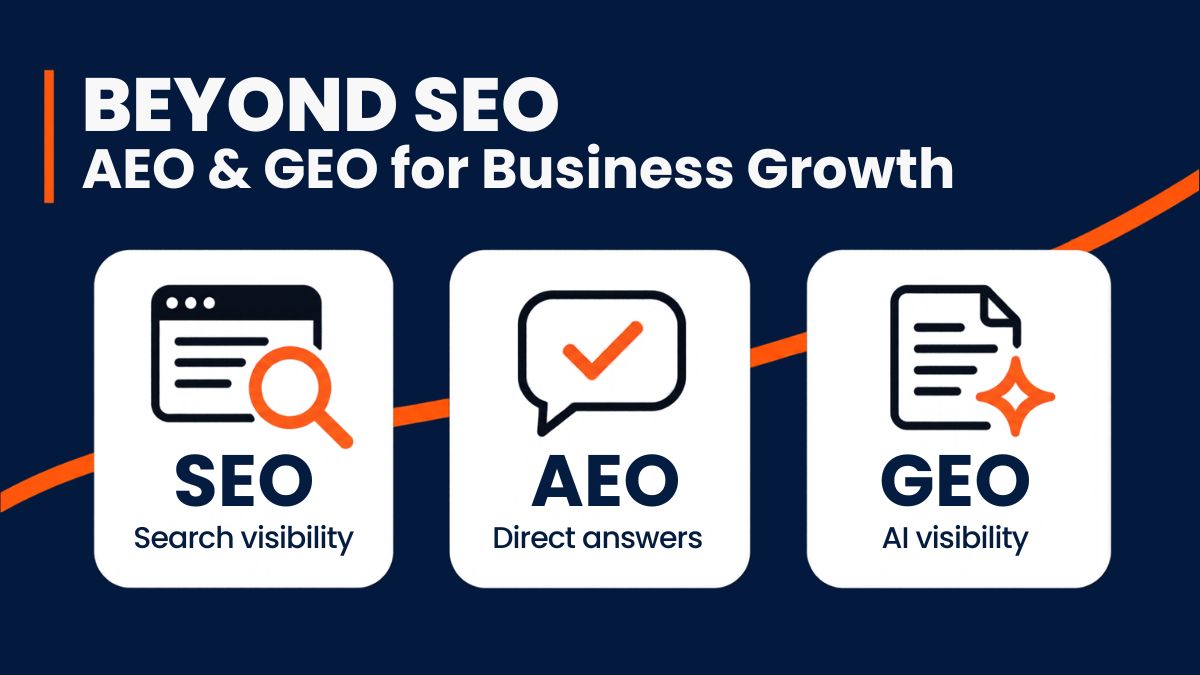
Beyond SEO: How AEO and
GEO Support Business Growth
Introduction
Customers discover businesses
through search results, direct answers, and AI-generated recommendations. To
reach them, businesses need helpful content, a trustworthy online presence, and
a website that turns interest into enquiries or sales. SEO (Search Engine
Optimization) is the practice of improving a website's content, structure, and
authority so that it ranks higher in unpaid (organic) search results on engines
like Google or gets cited in AI-assisted search tools.
How Does SEO Help Businesses Grow?
Imagine
a clothing store owner in Kathmandu whose current website is outdated, slow,
and does not allow customers to order clothes online. To improve their online
business, they search on Google: "Best website development company for
clothing stores in Nepal."
Here is how a local web development
company, Dirgha Technologies, attracts this client through SEO:
Step
1: Getting Discovered
Dirgha
Technologies has published a blog titled "How to Build a Professional
E-commerce Website for a Clothing Store in Nepal." The blog is
optimized with relevant keywords that potential customers might search for.
If the article is relevant,
useful, and competitive, it may appear prominently in search results.
Step
2: Building Trust with Potential Clients
The
clothing store owner clicks on the blog and finds useful information about
online clothing stores, product displays, shopping carts, online payment
integration, inventory management, and order tracking. This helps the owner
understand how Dirgha Technologies can help take their clothing business
online.
Step
3: Turning Visitors into Customers
At
the end of the blog, the owner sees a button saying "Get a Free Website
Consultation." They click the button and fill out the contact form to
discuss their website requirements.
Dirgha
Technologies receives an enquiry from a potential client interested in an
e-commerce website for their clothing business.
The Bottom Line: SEO can attract potential
customers without paying for each organic click, although it still requires
investment in content, website improvements, and ongoing work
Reasons why SEO alone is not
enough:
- Traffic
Does Not Equal Trust or Revenue:
Ranking high on Google brings visitors, but visitors will leave without
buying if your site lacks clear value, authority, or credibility.
- AI
Overviews and Direct Answers Change Search: Platforms like Google (via AI
Overviews) and AI assistants (like ChatGPT and Claude) often answer user
queries directly on the results page, reducing traditional click-through
rates to websites even when you rank well.
- Intense
Competition and Saturated Markets:
In competitive markets,
basic SEO may not be enough to stand out. Businesses also need useful
content, a clear offer, and evidence of their expertise.
- SEO
Takes Time:
Organic growth can take anywhere from several months to years to compound,
meaning businesses cannot rely on it alone when they need immediate
visibility, validation, or cash flow.
- Algorithm
Volatility:
Search engine updates can shift your rankings overnight, making a business
dangerously dependent on a single channel.
- Ignoring
Retention and Relationships:
SEO focuses heavily on top-of-funnel acquisition, often neglecting
customer retention, email marketing, follow-ups, and long-term brand
building
What
Are AEO and GEO, and Why Do Businesses Need Them?
1. AEO (Answer Engine Optimization)
Think of AEO as making your website
the answer people are looking for. When someone asks Google, Siri, or Alexa a
question, they sometimes get a direct answer instead of having to visit
different websites. AEO helps your content become one of the answers search
engines choose to show.
How
does it work?
- Write
clear and simple answers to common questions.
- Use
headings that match what people search for.
- Include
a Frequently Asked Questions (FAQ) section.
- Use
schema markup to help search engines understand your content.
Why
Do Businesses Need AEO?
Some searches end without a website
visit, making visibility within search results valuable alongside website
traffic. If a client asks, "What is the average cost of a e-commerce
websitein Nepal?", “A
clear”, well-supported price breakdown may improve the chances of your content
being selected as a direct answer, but selection is not guaranteed.
2.
GEO (Generative Engine Optimization)
Think
of GEO as helping your business get noticed and recommended by AI tools. Today,
people are using ChatGPT, Gemini, and Perplexity to find information, compare
services, and get business recommendations. GEO focuses on making your website
and business easier for these AI tools to discover, understand, and trust.
How
does it work?
- Publish
helpful and informative articles.
- Share
original research and practical insights.
- Build
a strong online reputation through genuine reviews and mentions.
- Keep
your business information accurate and consistent.
- Create
content that clearly answers people's questions.
Why
Do Businesses Need GEO?
Instead
of clicking ten different links to research a topic, users now ask an AI to
summarize the best options. GEO aims to improve the chances of your brand being
mentioned or cited in relevant AI-generated responses, although neither is
guaranteed
Differences between SEO, AEO, GEO:
|
Feature |
SEO (Search Engine Optimization) |
AEO (Answer Engine Optimization) |
GEO (Generative Engine
Optimization) |
|
Primary Goal |
Visibility in organic search |
Visibility in direct answers |
Visibility in generative AI
responses |
|
Typical Content |
Service pages, product pages,
articles |
Clear answers, definitions,
guides |
Original insights, detailed
explanations, credible evidence |
|
Visibility
measures |
Impressions, rankings, organic
clicks |
Appearances in relevant answer
features |
Relevant mentions, citations,
referral visits |
|
Shared foundation |
Helpful, accessible, trustworthy
content |
Helpful, accessible, trustworthy
content |
Helpful, accessible, trustworthy
content |
Marketing Strategies That Work
Alongside SEO
Let’s say you own a clothing store
in Kathmandu. SEO helps people find you on Google. But SEO alone isn’t enough.
Here are five other things that work with it.
1. AEO and GEO: Get Picked by AI
Today, many people ask ChatGPT,
Gemini, or Perplexity instead of searching on Google. Someone might type,
“Where can I buy trendy women’s kurtas in Kathmandu?” If your website clearly
says what you sell, your prices, and where your store is, AI may mention you in
its answer. If that information isn’t online, you’re simply not in the
conversation.
2. PPC Ads: Pay to Get Seen Fast
Paid advertising can generate
visibility quickly. PPC charges per click, while other advertising models use
different billing methods. Say you’ve just launched your Dashain collection. A
quick Instagram ad showing the new kurtas and dresses can bring people to your
shop right away, without waiting months to rank on Google.
3. Social Media: Build Community
Social media is where people get to
know your brand. Post new arrivals, outfit ideas, customer reviews, and short
videos. For example, a Reel showing five ways to style one kurta can get liked
and shared, and suddenly hundreds of new people know your store exists.
4. Content Marketing: Be Helpful,
Not Pushy
Instead of only saying “buy from
us,” share things people actually want to know. A blog post like “10 Kurta
Styling Ideas for Dashain and Tihar” will attract people searching for outfit
ideas. They read your tips, like what they see, and check out your collection.
Some become customers.
5. CRO: Turn Visitors into Buyers
Getting people to your website is
only half the job. If they leave without buying, you’ve wasted the effort.
Maybe your checkout is confusing or the delivery charge is hidden. Fix it: show
prices clearly, add a big “Order Now” button, keep checkout simple, and offer
easy payment options. Small fixes like these can mean more orders from the same
visitors.
How It All Fits Together
- SEO
helps people find you on Google.
- AEO
and GEO help AI tools know and recommend you.
- PPC
brings quick visitors through paid ads.
- Social
media builds your brand and keeps customers connected.
- Content
marketing attracts people by being useful.
- CRO
improves the chances that visitors complete a purchase or enquiry.
How Can Businesses Improve Their
Visibility Across Search Engines and AI Platforms?
Let's take the example of a
clothing store in Kathmandu. The goal is simple: when someone searches on
Google or asks ChatGPT, Gemini, or Perplexity for clothing stores in Kathmandu,
your business should have a chance to appear in the results.
1. Make Your Website Easy to Find
First, make sure search engines and
AI tools can easily find and understand your website.
- Keep
your website updated: Fix broken links, make sure pages load properly, and
display important information such as product details, prices, and contact
information.
- Use
schema markup: It helps Google understand what your business offers, where
it is located, and what products you sell. A developer can add this to
your website.
- Keep
business information consistent: Your business name, address, phone
number, and opening hours should be the same on your website, Facebook,
Instagram, and Google Business Profile.
2. Create Content That Answers
Customer Questions
Write content based on what
customers actually want to know. Give them a clear answer instead of writing
long introductions.
For example, if someone searches
"How to style a kurta for Tihar?", your blog should directly explain
how to style a kurta, which colours to choose, and what accessories to wear.
Use simple headings and common
words that customers normally search for, such as "Affordable kurtas in
Kathmandu" or "Best kurta designs for Tihar."
Also, include your own product
photos, styling tips, and useful information to make your content more
trustworthy.
3. Get Your Business Mentioned on
Other Websites
Your website is not the only place
that matters. What other people say about your business can also help build
trust.
- Get
customer reviews: Ask happy customers to share their shopping experience
on Google.
- Work
with bloggers and influencers: When local fashion bloggers mention or
recommend your store, more people can discover your business.
- Be
active on social media and online communities: Answer people's questions
about fashion and clothing on Facebook groups, YouTube, Reddit, and other
platforms. Focus on helping people rather than only promoting your
products.
For example, a customer review
saying "I bought a cotton kurta for Tihar from this store. The quality was
good and delivery was fast" gives people more useful information than
simply saying "Good store."
4. Check Whether Your Business
Appears in AI Answers
Don't just assume your business is
appearing in AI search results. Check it yourself.
Open ChatGPT, Gemini, or Perplexity
and ask questions like:
- Where
can I buy affordable kurtas in Kathmandu?
- Which
clothing stores sell trendy kurtas in Kathmandu?
- Tell
me about Riyasa Clothing Store.
Check whether your business appears
in the answers and whether the information is correct.
If your business doesn't appear,
look at your website content, customer reviews, and online business information
to see what needs improvement. You can also use tools like Google Search
Console and Semrush to monitor your website's search performance.
Conclusion
SEO remains an important foundation
for helping customers discover your business online. AEO and GEO build on that
foundation by focusing on how your content may appear in direct answers and
AI-generated responses. None of these approaches guarantees visibility or
sales, but clear information, useful content, and a trustworthy online presence
give your business a stronger starting point.
For a clothing store in Kathmandu
or a service provider like Dirgha Technologies, the next step is practical:
answer customer questions, keep business details accurate, improve the website
experience, and track enquiries and sales. Combine these efforts with relevant
advertising, social media, and customer follow-ups to turn online discovery
into lasting business growth.