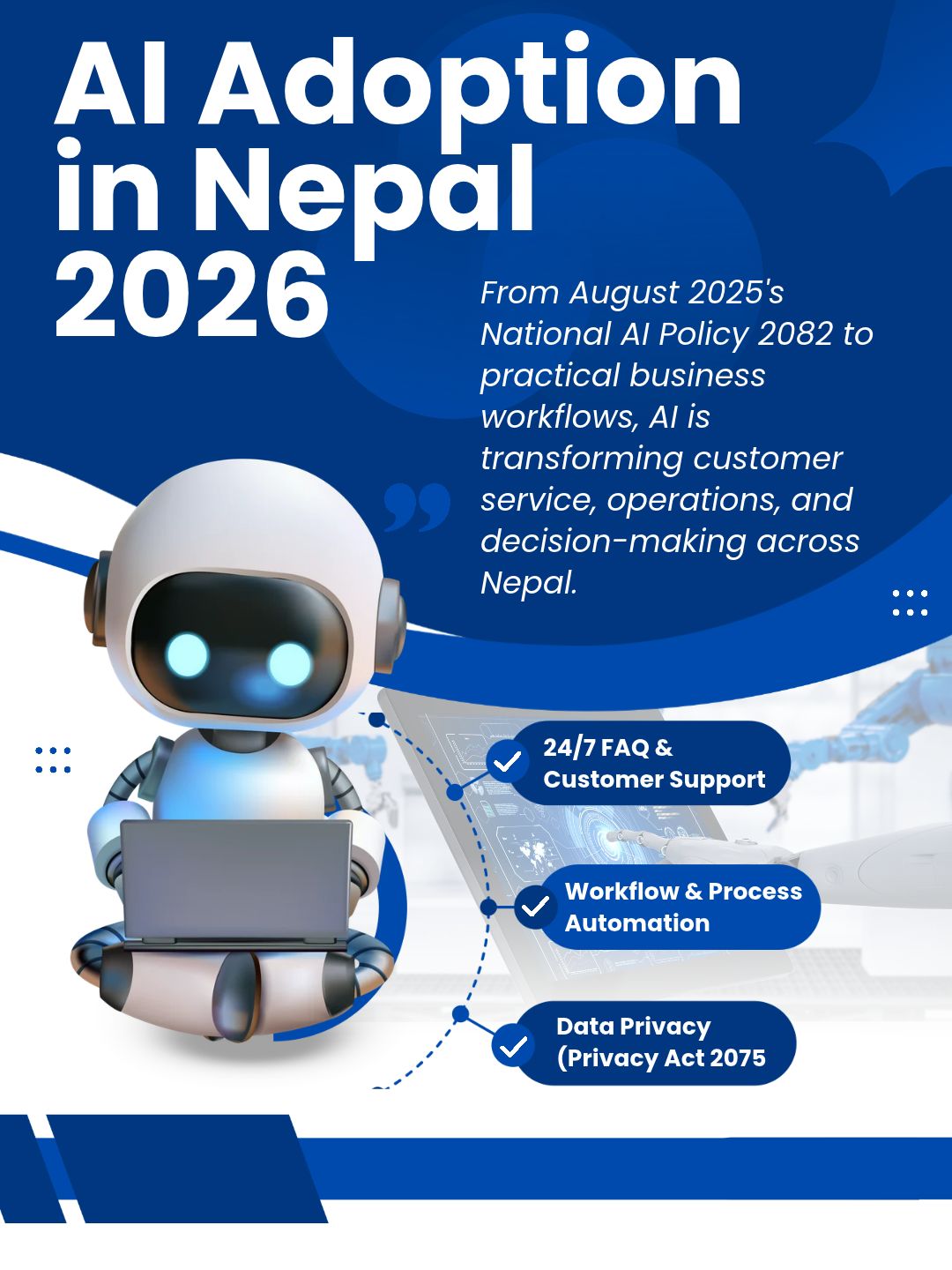
Artificial intelligence isn't stuck in research labs anymore. Businesses everywhere are using it to answer customer questions, write content, analyze data, and automate boring, repetitive work.
For
Nepali businesses, the real question in 2026 isn’t whether AI is available or
not? The real question is: do we have the data, people, and processes to
actually use it well?
Nepal
has taken a big step here too. In August 2025, the government approved the
National AI Policy 2082, a national framework covering AI infrastructure,
skills, ethical use, and adoption across sectors. So, 2026 isn't about whether
AI reaches Nepal, it's about how businesses adopt it responsibly and turn it
into real value.
What Does "AI
Adoption" Actually Mean?
AI
adoption is the integration of artificial intelligence tools into daily
workflows and business operations to boost efficiency and productivity.
For
example, if an employee uses ChatGPT once to write an email, that is just
trying AI. But if a company uses AI regularly to answer customer questions,
summarize documents, or create marketing content, that is AI adoption.
Businesses
don’t need to create complicated AI systems. They can start with simple tasks,
like answering common questions, reducing repetitive work, saving time, and
helping employees work faster.
Purpose of Using AI for
Business
Businesses are using AI
for following purposes:
- Customer
service -
Chatbots that answer FAQs, offer support after hours, and route tricky
questions to a human.
- Marketing
& sales -
Drafting content, personalizing messages, spotting leads, analyzing
campaigns.
- Operations
& HR -
Handling paperwork, scheduling, recruitment support, and internal
knowledge lookup.
- Finance
- Spotting
unusual transactions, supporting forecasts, organizing financial records.
Why AI Matters for Nepal
Right Now
Nepali
businesses are already going digital- websites, digital payments, social media,
cloud tools, and online stores are becoming the norm. All of that activity
generates data, and data is exactly what AI needs to deliver value.
Combined
with the National AI Policy 2082, this shift creates a genuine opportunity to:
- Work
faster and eliminate repetitive tasks
- Improve
customer experience
- Make
smarter, data-backed decisions
- Compete
more effectively in digital markets
However,
Nepal still faces significant gaps in skills, infrastructure, data quality, and
funding.
The Opportunities
1.
Better customer service: People
expect fast replies on websites and social media now. AI can handle routine
questions around the clock, freeing up staff for harder problems.
2.
Stronger marketing on a small team: AI
can draft content, segment customers, and analyze campaigns helpful for
businesses that can't afford a big marketing department.
3.
Less manual busywork: Data
entry, document processing, report writing a lot of this can be automated,
saving real employee time.
4.
Smarter use of existing data:
If a business already tracks sales, customer inquiries, or website traffic, AI
can help answer questions like: Which products sell best? Which customers
matter most? When does demand spike?
5.
A real edge for small businesses: Small
companies can't hire big specialist teams but they can use affordable,
ready-made AI tools for support, content, summarizing documents, and basic
analysis.
The Challenges Nepali
Businesses are Facing while adopting AI
1. Cost: AI isn't free- subscriptions,
integration, and training add up. A 2026 report by Zunkiree Labs (surveying 50+
organizations) found that only 31.8% of businesses had a dedicated AI budget,
with costs ranging anywhere from NPR 50,000 to NPR 50 million depending on the
project. Most SMEs should start with affordable, ready-made tools before making
large investments.
2. Skills gap: A study of
Nepali industries found that 56% cited small market size and a lack of skilled
talent as major barriers. AI skills need to be part of the adoption plan from
day one, not an afterthought.
3. Messy data: AI is only as
effective as the information it receives. Paper records, scattered
spreadsheets, and disconnected software all hold AI back. Fixing basic
record-keeping often has to come first.
4. Connecting systems: AI
tools need to integrate with existing software such as accounting, CRM, and
inventory platforms. For digitally mature businesses, this is straightforward.
For others, it may require digitizing operations first.
5.
Privacy and security:
Employees might paste customer data or financial details into public AI tools
without considering data destination risks. Nepal's Individual Privacy Act,
2075 makes this a legal concern, not just a matter of best practices.
Businesses need clear guidelines on what can and cannot be entered into AI
tools.
6. Employee fear: Staff often
assume AI implementation leads to job cuts. Being upfront that the goal is
eliminating repetitive work, not replacing people helps reduce workplace
resistance.
7. Using AI without a plan:
Knowing how to use ChatGPT is not the same as understanding how AI fits into
your business model. Before adopting any tool, a business should be able to
answer: What problem are we solving? How will AI help? How will we know it
worked?
8. Accuracy and risk: AI makes
errors and can sound confident while being completely wrong. Critical outputs
still require human oversight and verification.
Before
adopting any tool, a business should be able to answer: What problem are we
solving? How will AI help? How will we know it worked? AI makes mistakes. AI
can sound confident while being wrong. Important outputs still need a human to
check them.
Is Nepal's Business
Sector Ready?
There's
no single yes-or-no answer, readiness varies a lot by business.
Nepal
scored 37.5 on Oxford Insights' 2025 Government AI Readiness Index but
that measures government readiness, not private businesses, so it shouldn't be
read as a company ranking.
In
book: Handbook of Research on Artificial Intelligence in Government Practices
and Processes (pp.210-225). Published by IGI Global
- 20.8%
were ready in terms of technology
- 29.9%
were ready in terms of management
- 39.2%
were ready in terms of potential business value
Nepal
isn't starting from zero, but readiness is uneven, some businesses are ahead,
many still have groundwork to do.
A Quick Readiness Check
Before
investing in AI, ask your business:
|
Readiness area |
Question to ask |
|
Digital
infrastructure |
Do
we have reliable digital systems and connectivity? |
|
Data |
Is
our business data accurate, organized and accessible? |
|
Skills |
Do
employees know how to use and evaluate AI tools? |
|
Leadership |
Is
management prepared to support the change? |
|
Budget |
Can
we afford implementation and ongoing costs? |
|
Security |
Can
we protect customer and business information? |
|
Processes |
Are
our workflows organized enough to automate? |
|
People
and culture |
Are
employees prepared to work alongside AI? |
|
Strategy
and ROI |
Can
we identify a measurable business problem AI can solve? |
How to Actually Get
Started
1. Find a real problem: First, identify a problem
that AI can solve. For example, if staff spend hours answering the same
customer questions every day, AI can handle those simple questions and save
time.
2.
Pick the simplest tool for the job: Don't
overthink a chatbot might be all you need.
3. Check your data first: Is your customer and sales
info accurate and accessible? Fix this before building anything advanced.
4.
Run a small test: Test
on one low-risk process like a hotel testing AI for guest FAQs before touching
its booking system.
5.Train
your team: Cover
what AI can and can't do, how to check its output, and when not to use it.
6. Protect sensitive data: Set clear rules before employees start using
AI tools, no passwords, contracts, or confidential info in random tools.
7. Measure real outcomes: Did AI response times improve? Did staff save
time? Track actual results, not just usage.
8. Scale what works: Once a small test succeeds, document it, fix any
issues, and expand to other areas.
What to Avoid?
- Adopting
AI just because it's trendy
- Automating
a broken process instead of fixing it first
- Trusting
AI output without a human check
- Feeding
confidential data into random AI tools
- Trying
to overhaul everything at once
- Measuring
success by "AI usage" instead of real business results
- Leaving
employees out of the conversation
AI
is quickly becoming a built-in part of everyday business software: CRMs,
accounting tools, marketing platforms rather than a separate, specialist
technology.
That
means the real competitive edge won't be who has access to AI (soon, everyone
will). It'll be who knows how to use it well. Businesses with organized data,
trained staff, and clear goals will pull ahead.
Conclusion
AI
adoption in Nepal is moving from curiosity to real business use. The
opportunities, faster service, less busywork, smarter decisions are real. So
are the challenges: cost, skills, data quality, and security.
The
smartest way isn't chasing the newest AI tool. It's asking one simple question
first: What business problem can we actually solve with AI?
From there, assess your readiness, start small, train your people, protect your data, measure results, and scale what works. For Nepali businesses heading into the rest of 2026, that problem-first mindset matters more than the technology itself.